KACST President Highlights Saudi Arabia’s Experience in Strengthening Trust in Science at High-Level International Panel in Japan
The Kingdom of Saudi Arabia participated in the 23rd Annual Meeting of the Science and Technology in Society (STS) Forum, held in Kyoto, Japan, with the participation of leading scientific and technology figures, policymakers, and heads of research, academic, and industrial institutions from around the world.
The forum addressed the rapid transformations in science and technology and their implications for societies and the future of development. Discussions covered trust in science, artificial intelligence, open science, and the future of scientific research, as well as the responsibility of scientific institutions to balance the opportunities offered by advanced technologies with the responsible management of their challenges.
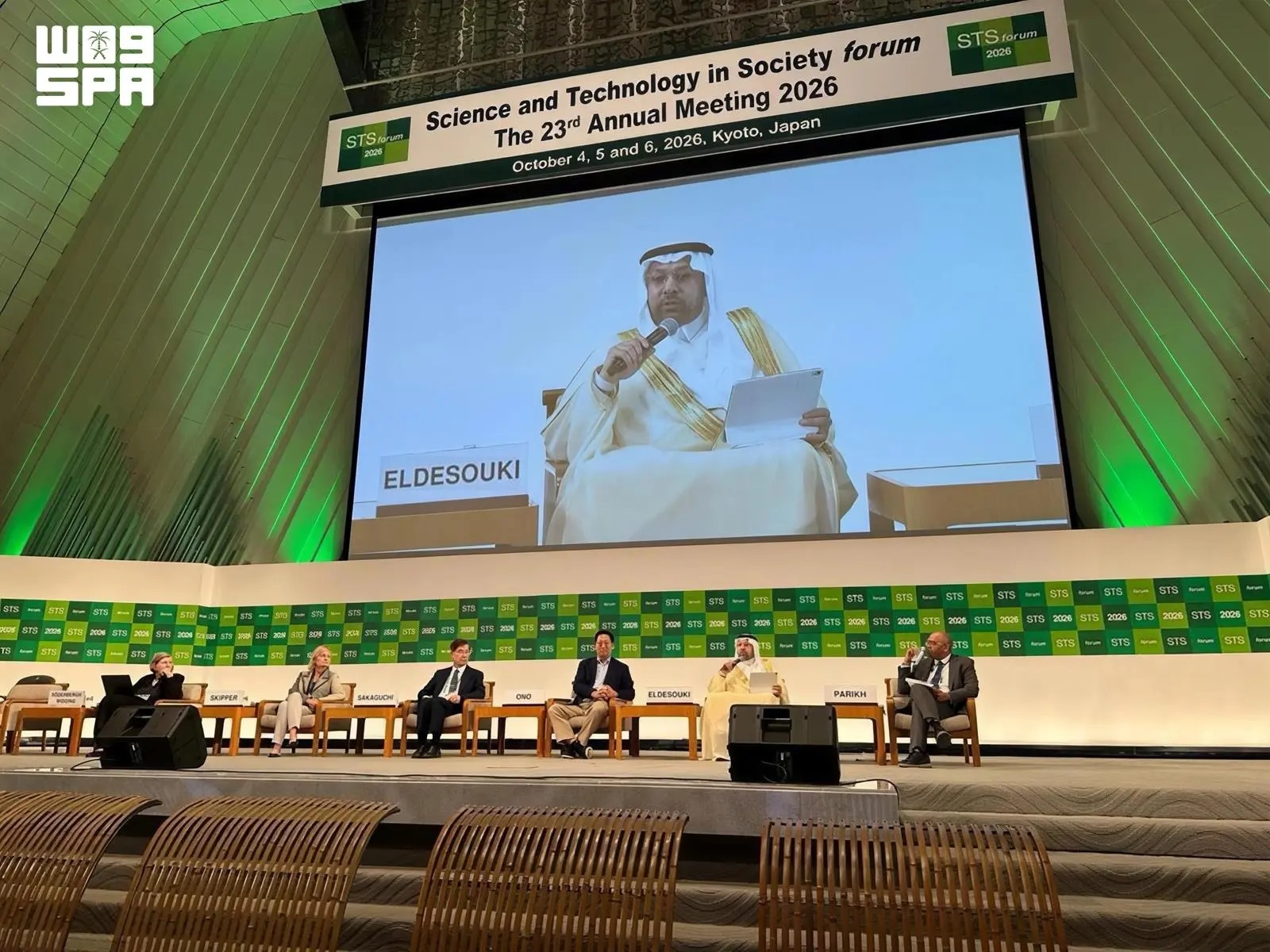
President of King Abdulaziz City for Science and Technology (KACST) and Acting Governor of the Research, Development and Innovation Authority Dr. Munir Eldesouki spoke at the plenary session titled “Why Trust Science?” following his appointment as a distinguished member of the STS Forum Council. He was joined by Japan’s Minister of Education, Culture, Sports, Science and Technology Yoshihiro Seki; Japanese scientist Professor Shimon Sakaguchi; Editor-in-Chief of Nature Magdalena Skipper; Chair of the Board of the Nobel Foundation Astrid Söderbergh Widding; and Professor Santa J. Ono. The session was chaired by Chief Executive Officer of the American Association for the Advancement of Science Dr. Sudip Parikh.
During the session, Dr. Eldesouki highlighted several directions for building a more open and trusted research ecosystem, noting that trust in science is grounded in scientific humility, openness, and accountability, as well as in the scientific community’s ability to review, verify, and transparently correct its findings.
He emphasized the Kingdom’s direction toward expanding access to national research infrastructure for researchers and innovators, enabling broader use of laboratories, facilities, and scientific capabilities. He also highlighted the advancement of open science principles to support research quality and the reliability of scientific findings, strengthen their testability, verification, and reproducibility, and expand opportunities for scientific collaboration and knowledge exchange locally and internationally.
Dr. Eldesouki also addressed the Kingdom’s investments in Arabic-language artificial intelligence models and its progress in AI ethics and governance, supporting the development of technologies that reflect linguistic and cultural diversity, enhance the reliability of intelligent systems, clarify accountability for their decisions, and enable their outputs to be examined and verified.
Dr. Eldesouki commended the STS Forum for providing a high-level international platform that brings together scientific and technology leaders from around the world. He also recognized the efforts of the forum’s organizers in strengthening dialogue, exchanging perspectives and expertise, building bridges for international cooperation, and anticipating the opportunities and challenges associated with scientific and technological advances, helping direct their impact toward serving people and advancing development.
The Kingdom’s participation in the forum reflects its continued contribution to strengthening international scientific cooperation, building strategic partnerships, exchanging knowledge and expertise with leading scientific and research institutions, and contributing to international discussions on the future of science and emerging technologies.