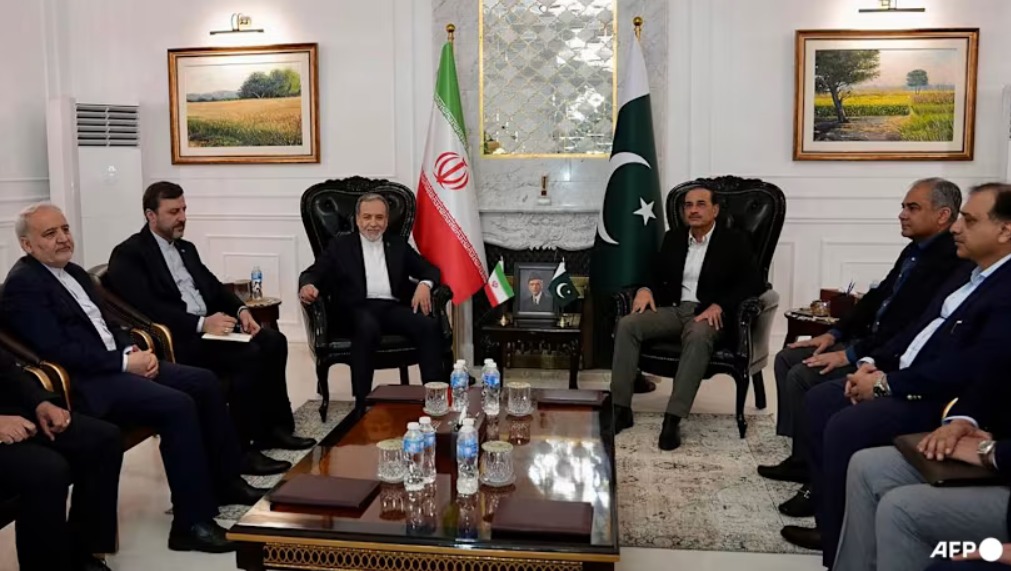
 Pakistan's Army Chief and Field Marshal Syed Asim Munir (third from right) meeting with Iran's Foreign Minister Abbas Araghchi (third from left) upon his arrival in Islamabad, in this photo released on Apr 25, 2026. (Photo: Handout via AFP/Iranian Foreign Ministry)
Iran's foreign minister leaves Islamabad after talks with Pakistani officials: State media
Iranian Foreign Minister Abbas Araghchi departed Islamabad on Saturday (Apr 25), having arrived the day before for meetings with senior Pakistani officials to discuss peace talks with the United States.
Washington and Tehran held a first round of direct talks in the Pakistani capital two weeks ago, after agreeing a temporary ceasefire in the US-Israeli war with Iran, but the two sides are yet to hold to a second round.
US envoy Steve Witkoff and presidential son-in-law Jared Kushner were also expected to visit Islamabad on Saturday, with White House Press Secretary Karoline Leavitt saying they would "engage in talks ... with representatives from the Iranian delegation".
"The Iranians reached out, as the president called on them to do, and asked for this in-person conversation," Leavitt said, adding that the talks would "hopefully move the ball forward towards a deal".
However, US President Donald Trump said in an interview with Fox News on Saturday that he had cancelled Witkoff and Kushner's trip to Pakistan.
Iranian state media said Araghchi had no plans to meet with the Americans, and Islamabad would serve as a bridge to "convey" Iranian proposals.
In Islamabad, Araghchi met Field Marshal Asim Munir, Pakistan's army chief and a key figure in the country's mediation efforts, and Prime Minister Shehbaz Sharif.
Aragchi, according to a statement from the foreign ministry, thanked Pakistan for its efforts to establish the ceasefire but also "explained our country's principled positions regarding the latest developments related to the ceasefire and the complete end of the imposed war against Iran".
A Pakistani source involved in the talks told Reuters on Saturday that Araghchi delivered Tehran's negotiating demands, as well as its reservations about US demands, to Pakistani officials during his visit to Islamabad.
An Iranian spokesman said Araghchi would later visit Oman and Russia to discuss efforts to end the war, which was launched against Iran by Israel and the United States on Feb 28.
Iran's top military command said on Saturday that US forces will face Tehran's reaction if they continue their "blockade and piracy in the region", according to Iranian state TV.
Sealing a deal to end the Middle East war remains a thorny proposition, even as urgency mounts to reopen the Strait of Hormuz, a vital conduit for the world's oil and liquefied natural gas (LNG).
OPENING HORMUZ "VITAL"
Iran's military, meanwhile, remained defiant on Saturday.
In a statement carried by state media, the military's central command said that if "the invading US military continues blockading, banditry, and piracy in the region, they should be certain that they will face a response from Iran's powerful armed forces".
Tehran's defence ministry, in a statement carried by news agency ISNA, said: "Our military power today is a dominant force, and the enemy is looking for a face-saving way to escape the war quagmire it has become trapped in."
Since the last round of talks, efforts to bring the two sides back to the table have hit an impasse, with Iran refusing to participate as long as a US naval blockade on its ports remains in place.
Iran has imposed a de facto blockade of its own on the Strait of Hormuz, allowing only a trickle of ships to pass through the vital waterway, throwing global energy markets into turmoil.
Oil prices slid on Friday amid hopes that fresh peace talks would see an end to Tehran's disruption of trade through the strait.
European Council President Antonio Costa said the strait "must immediately reopen without restrictions and without tolling".
"This is vital for the entire world," Costa said.
"DESTROYED"
On Thursday, Trump announced a three-week ceasefire extension in Lebanon and spoke in glowing terms of peace prospects for the country after meeting with Israeli and Lebanese envoys.
He voiced hope for a three-way meeting with Lebanon and Israel's leaders.
The two countries have been officially at war for decades and until last week, officials had not met directly since 1993.
But Mohammed Raad, the head of the parliamentary bloc for Iran-backed armed group Hezbollah, urged the Lebanese government to withdraw from direct talks with Israel and warned that a lasting peace deal of the kind sought by Trump "will in no way enjoy Lebanese national consensus".
Israeli Prime Minister Benjamin Netanyahu, who has vowed to destroy Hezbollah, said: "We have started a process to reach a historic peace between Israel and Lebanon, and it's clear to us that Hezbollah is trying to sabotage this."
Despite the ceasefire, Lebanon's health ministry said Israeli strikes on Saturday in the Nabatieh district of the south of the country had killed four people.
In the coastal city of Sidon, Ahmad Shumar and his family were preparing to head back to their hometown in the south this week, after giving up on a previous attempt due to fears of Israeli attacks.
"We are going home now, not knowing whether there will be war or peace - we will see," the 74-year-old said, surrounded by bags and mattresses.
While Shumar said he hoped the ceasefire became permanent, he rejected any direct talks between Lebanon and Israel.
"Direct negotiations mean recognising the enemy," which he said he could not abide.
In south Lebanon's Tyre, Mohamad Ali Hijazi was searching a mountain of rubble for mementos of family members killed in an Israeli airstrike minutes before the ceasefire took hold.
"I'm trying to find my mother's hairbrush ... and a bottle of perfume that she loves," said Hijazi, 48.
"My life has been destroyed. I haven't slept for five days," he told AFP, fighting back tears.